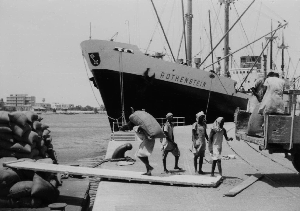
Cargo ships carry the largest amount of load across continents than with any other means. In 1800s the ships started getting bigger as the technology improved carrying even more load than ever before. At the begining the cargo was just dumped onto the ship's deck, then at the port they were unloaded one by one by hand (Fig. 1), in the same way a transit van is unloaded. This was very costly and time consuming.
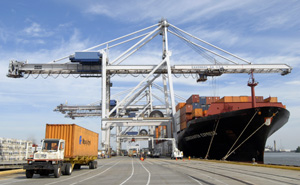
Eventually they introduced containers so they can be loaded and unloaded quickly. This enabled unloading and loading the containers using a cranes (Fig. 2).
Solution
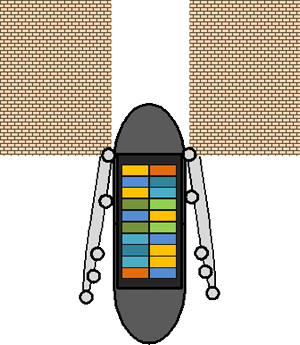
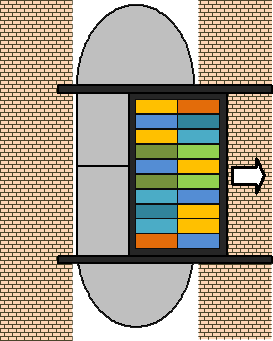
Today they use very large cranes operated at high speed to unloaded the cargos. But there is still room for improvement to reduce the cost. Instead of unloading each container one by one, it should be possible to simply unload the entire deck or in sections at once. This is an ideal solution for cargos on ship. The entire load is placed on a removable platform that sits on the ship deck with extended sides (fig. 3), the ship will drive into a V shape opening (Fig 4) with flexible arms that guides the ship gently into the dock. Then the entire deck is shifted out onto land using rails.