The Problem
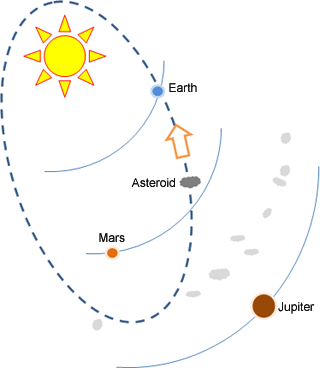
Asteroids can cause mass-extinction and there are millions of them flying around our solar system. They are the most dangerous, but at the same time, the only preventable of the disasters. There are over 1,500 known earth-crossing asteroids, which astronomers are constantly tracking. They pose no danger to us at the moment. However, every often an asteroid will pass a massive body such as a planet, especially jupiter, that alters its course. Astronomers will not know of that unless they are spotted again and their orbit is recalculated. If one asteroid changes course and head towards us, there is a high chance that it goes undetected or we detect it too late. Too late means, scientist need enough time to react to the danger. That includes building rockets and working out the most suitable deflection or destruction method, since doing it the wrong way can make the mater worse.
Solution
Scientists have started planning for a mission to an asteroid that has the most chance of begin deflected towards Earth. This experiment is meant to test if a potentially dangerous asteroid can be tracked with certainty and detect any changes in its orbit. There was a competition based on this idea in 2009, which I entered but have not heard of any development on that since.
My solution, which I entered in the competition was to use GPS. Since satellites are sending to orbit outer planets (Fig. 1), they can be used as GPS satellites. Since the distances between planets are very large, the accuracy will be much higher than an earth-bound GPS and also fewer satellites will be required
The mission will be to place a GPS receiver and a transmitter which will be solar powered with very low battery consumption. It will come out of hibernation every month and calculates its position, returns the result and hibernates again.